The Burnout Signal Your Team Is Sending That You Are Missing
Burnout rarely announces itself. The team member who is heading toward it does not send a message saying they are overwhelmed. They send a series of smaller signals that are easy to misread as other things: the response times that get slightly longer, the meeting contributions that become slightly thinner, the work quality that stays adequate but loses its ambition. By the time the burnout is visible as a resignation or a performance issue, it has been building for months through signals that the manager had the tools to see but not the infrastructure to surface systematically. The organizations that have the lowest burnout rates among high performers are not the ones that offer the best wellness benefits or the most flexible policies. They are the ones that have built a working environment where the conditions that precede burnout, overload, unclear priorities, invisible contribution, and disconnected management, are surfaced by the system rather than left to the manager’s observation. That environment is built on project management tools that make workload, direction, contribution, and communication visible as structural features of the daily working experience.
Table of Contents
Direction that prevents the overwork trap with Lark OKR
One of the most consistent drivers of burnout is effort that does not feel purposeful. The team member who works long hours on tasks that do not connect visibly to anything that matters to the organization experiences the exhaustion without the compensating sense of contribution. They are working hard and going nowhere, and eventually they stop working hard.
Lark OKR makes the connection between individual effort and organizational purpose visible and permanent. Every team member can see how their key results connect to the team’s objectives and how those objectives connect to the company’s direction, so the work they are putting in has a visible destination rather than disappearing into an organizational void. Individual check-in cycles within the OKR framework prompt regular conversations about whether the work someone is doing still matches the priorities they signed up to deliver, creating a structural early warning for the drift between effort and impact that precedes many burnout experiences.
Communication that signals before the crisis with Lark Messenger
The manager who relies on observation to detect burnout is working from an inherently incomplete signal. They see the team member in meetings and read their messages, but they do not see the pattern of those messages over time, the gradual withdrawal, the shortening replies, the reduced initiative that characterizes someone who is approaching their limit.
Lark Messenger’s “Scheduled Messages” allow managers to maintain consistent, warm communication with their team regardless of schedule differences, so the relationship that makes a team member willing to flag their own overload before it becomes a crisis is maintained even when the manager’s attention is stretched across multiple direct reports. “Read/Unread Status” gives managers a gentle signal when team members who normally read messages quickly start leaving them unread, which is often one of the first behavioral signals of disengagement without requiring the manager to explicitly monitor individual behavior. Group folder organization allows managers to maintain distinct communication contexts for operational updates and personal check-ins, so the personal communication that builds the relationship where burnout can be discussed is not crowded out by operational noise.
Workload that is visible before it becomes unmanageable with Lark Calendar
Overload is a prerequisite for burnout, and overload is often invisible to the people who are causing it. The manager who adds one more project to a team member’s plate does not see the accumulated weight of everything that was already there. The team member who accepts the additional work does not want to appear unable to handle it. The result is a load that builds beyond sustainable capacity without anyone explicitly deciding to push past the limit.
Lark Calendar “Calendar Subscription” allows managers to see shared focus-time blocks and committed workload across their team, so the decision to add another project is based on actual capacity information rather than the assumption that the team member has room. “Schedule in Chat” makes the distribution of meeting load visible when a new meeting is being arranged, so the team member who is already attending more meetings than their peers is protected by the visibility of that load rather than absorbing additional demands because their availability appears open.
Contribution that is seen, not assumed with Lark Docs
A specific form of burnout driver is the experience of doing significant work that receives no visible recognition because the attribution is unclear or the contribution was never explicitly acknowledged. The team member who did the substantive analysis that drove a key decision but was not in the room when the decision was praised stops feeling that the effort is worth making.
Lark Docs makes every contribution visible and attributable. “Version History” provides a permanent record of who contributed what and when, so the team member who drove the substantive content of a document has an objective record of that contribution even if their name was not the one mentioned in the meeting where the work was praised. “Comment” threads that capture the intellectual back-and-forth of refining a piece of work show the quality of thinking that went into the final output rather than just the final output itself, giving managers and peers visibility into the process as well as the product.
A workload picture that updates itself with Lark Base
Burnout driven by task overload is often invisible because the task load is not tracked in a way that makes the accumulation visible. Individual contributors manage their own task lists in their own tools, and the organization has no aggregate view of how much work is in progress across the team. The manager who assigns a new task does not see the queue it is joining.
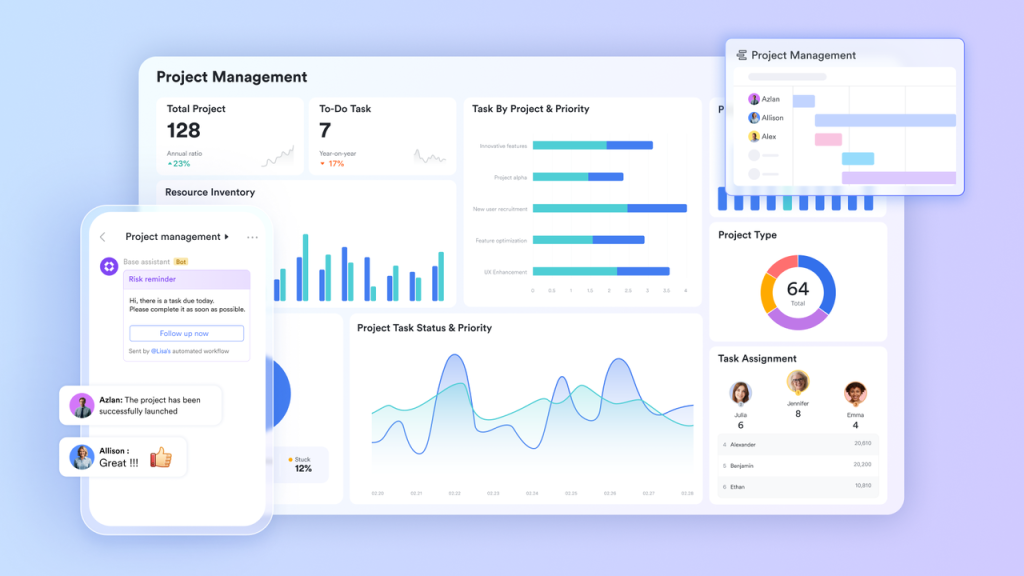
Lark Base gives every manager a live view of their team’s current task load through shared dashboards and personal task views. When a team member’s workload in the Base record is visibly heavy relative to their peers, the manager has an objective basis for a workload conversation rather than having to rely on the team member volunteering that they are overwhelmed. Automated notifications alert the manager when a team member has an unusually high number of overdue items, which is often a behavioral signal of overload rather than a performance issue, surfaced by the system rather than discovered through observation.
Bonus: Why wellness programs do not address operational burnout
Organizations that recognize burnout as a serious risk typically respond with wellness initiatives: mental health days, EAP programs, meditation app subscriptions, and resilience training. These programs address the consequences of burnout without changing the conditions that produce it. The team member who is burned out because they are overloaded and their contribution is invisible does not benefit meaningfully from a meditation app. They benefit from a lighter load and a manager who sees their contribution.
Tools like Lattice and Culture Amp measure burnout risk through surveys. Slack and Microsoft Teams provide communication channels that can carry the conversation about wellbeing. But neither addresses the operational conditions, the unclear priorities, the invisible workload, the unattributed contribution, and the inconsistent management attention, that generate burnout in the first place. Teams evaluating Google Workspace pricing often realize that collaboration software is only one part of the broader operational stack. Many still add separate wellness platforms to monitor burnout, even though the workflows contributing to burnout continue inside other tools. Lark addresses those operational conditions more directly.
Conclusion
Burnout is not prevented by wellness programs. It is prevented by working environments where surface overload before it becomes unsustainable, make contributions visible before it becomes invisible, maintain management connection before it becomes distant, and keep priorities clear before they become confused. A connected set of productivity tools that makes each of these conditions a structural feature of daily working experience is how organizations protect their best people from the burnout that high-performing work environments too often produce.

Tech Buzz Info Provides the Better Information on latest and trending technologies across the world. we also concentrate on the Business Trends, Marketing Trends, Gadget releases and many more trending topics